Concept · 2026
CareMatch
Outcomes
The context — the problem, from the inside
The NDIS promises participants choice and control over their supports. In practice, matching is opaque: participants are often assigned whoever is available rather than choosing who suits their needs; support workers can't showcase their specific skills, experience or personality before a placement; and providers sit in the middle with little visibility working in any direction. For people with specific needs — sensory, behavioural, cultural, communication — the difference between the right worker and the wrong one is enormous, and the current system treats it as interchangeable.
The insight
Every other high-stakes personal match — hiring, renting, even dating — gives both sides a profile and a choice. Support work, one of the most personal services that exists, gives them neither.
The concept — three connected profiles
- Participants build a profile of their needs, preferences, routines and goals — and browse, shortlist and choose workers who fit, rather than accepting an assignment.
- Support workers create portfolios showcasing verified credentials, specialisations (e.g. autism support, complex care, AAC communication), languages, interests and availability — under their employer or independently.
- Providers/employers list their organisation, their standards, and their teams — with their workers' profiles visible underneath, turning transparency into a competitive advantage for good employers.
What this demonstrates
Problem discovery from lived experience, two-sided marketplace thinking, trust & safety design, and regulated-domain awareness — the same compliance-first instinct I used in lending at Bridgit, applied to disability services.
Status & next steps
I've built a clickable prototype of the participant-side matching flow using AI-assisted tools. Next: structured interviews with participants, workers and coordinators to test whether the matching criteria I've drafted reflect what actually predicts a good placement.
The three profiles
Three sides, one mutual choice
Participant
- Needs & preferences
- Routines & goals
- Shortlist & choose
Support Worker
- Verified credentials
- Specialisations
- Availability
Provider
- Organisation & standards
- Team of workers
- Transparent listings
Every arrow runs both ways: participants choose workers, workers accept or decline placements, providers earn visibility for the teams they build.
The shift
Today vs CareMatch
Today
- Assigned a worker
- No visibility into who they are
- No voice in the match
- Change requires a complaint
With CareMatch
- Browse workers who fit
- See credentials & specialisations
- Shortlist, choose, review
- Change any time, mutually
Key design decisions
Four principles the concept is built on
Trust is the product.
Verification comes first: NDIS Worker Screening Check status, qualifications and employer attachment are surfaced on every worker profile. In a platform serving people in vulnerable situations, safety features aren't a compliance layer — they're the core value.
Choice must work in both directions.
Workers accept or decline matches too. Good matching is mutual — a worker who chose the placement stays longer, and continuity is one of the things participants value most.
Transparency as the business model.
Providers might resist exposing their workers to visibility — but the ones with great teams gain a recruiting and client-acquisition edge. The platform is designed to make transparency the winning strategy.
Accessibility isn't a feature tier.
The primary users include people with disability, so the design baseline is WCAG-compliant, screen-reader-first, with easy-read content options — designed from the first wireframe, not retrofitted.
From the prototype
Screens from the working build
A clickable prototype of CareMatch is live — these are screens taken straight from it.
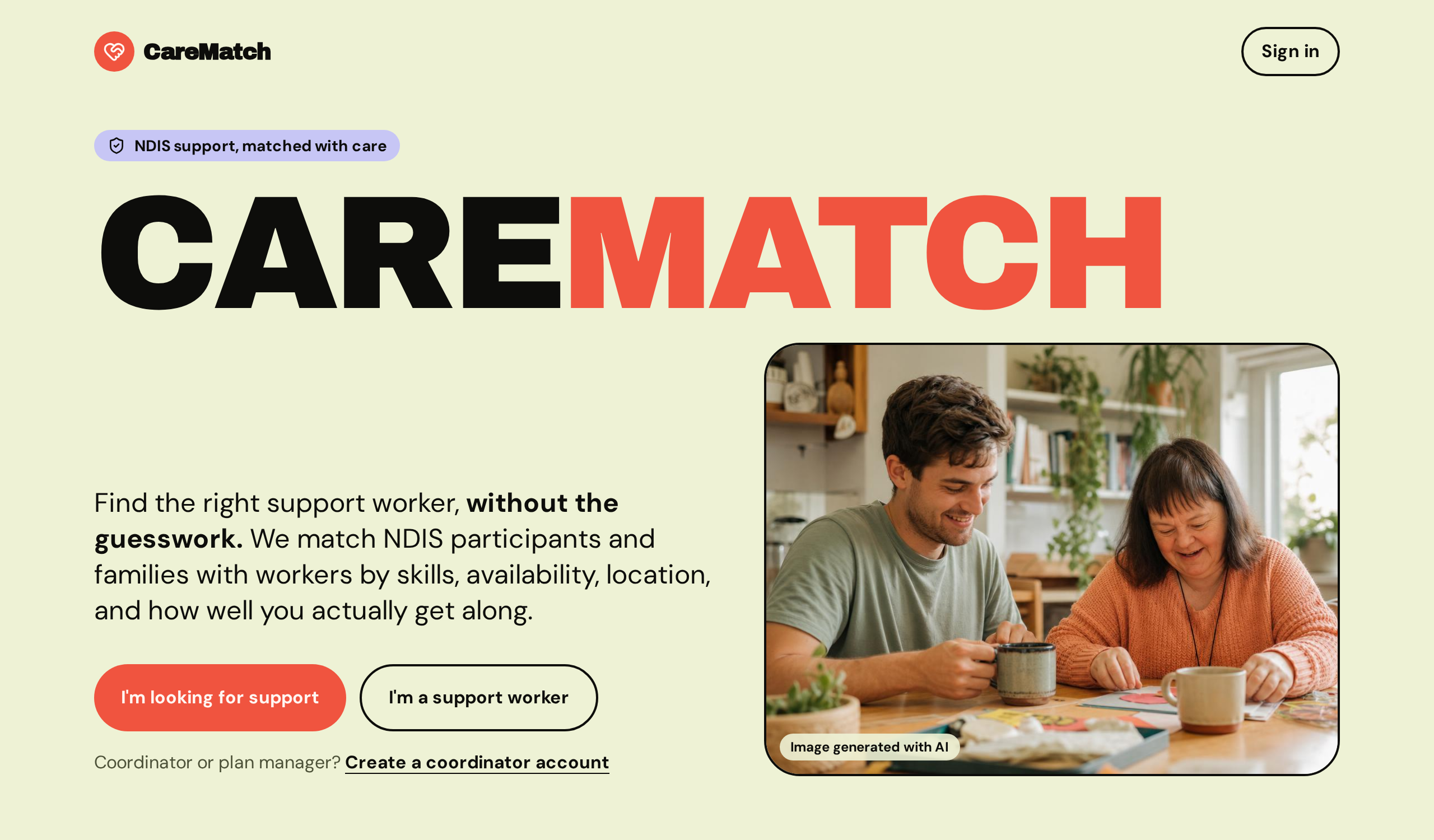
The promise up front: find the right support worker, without the guesswork.
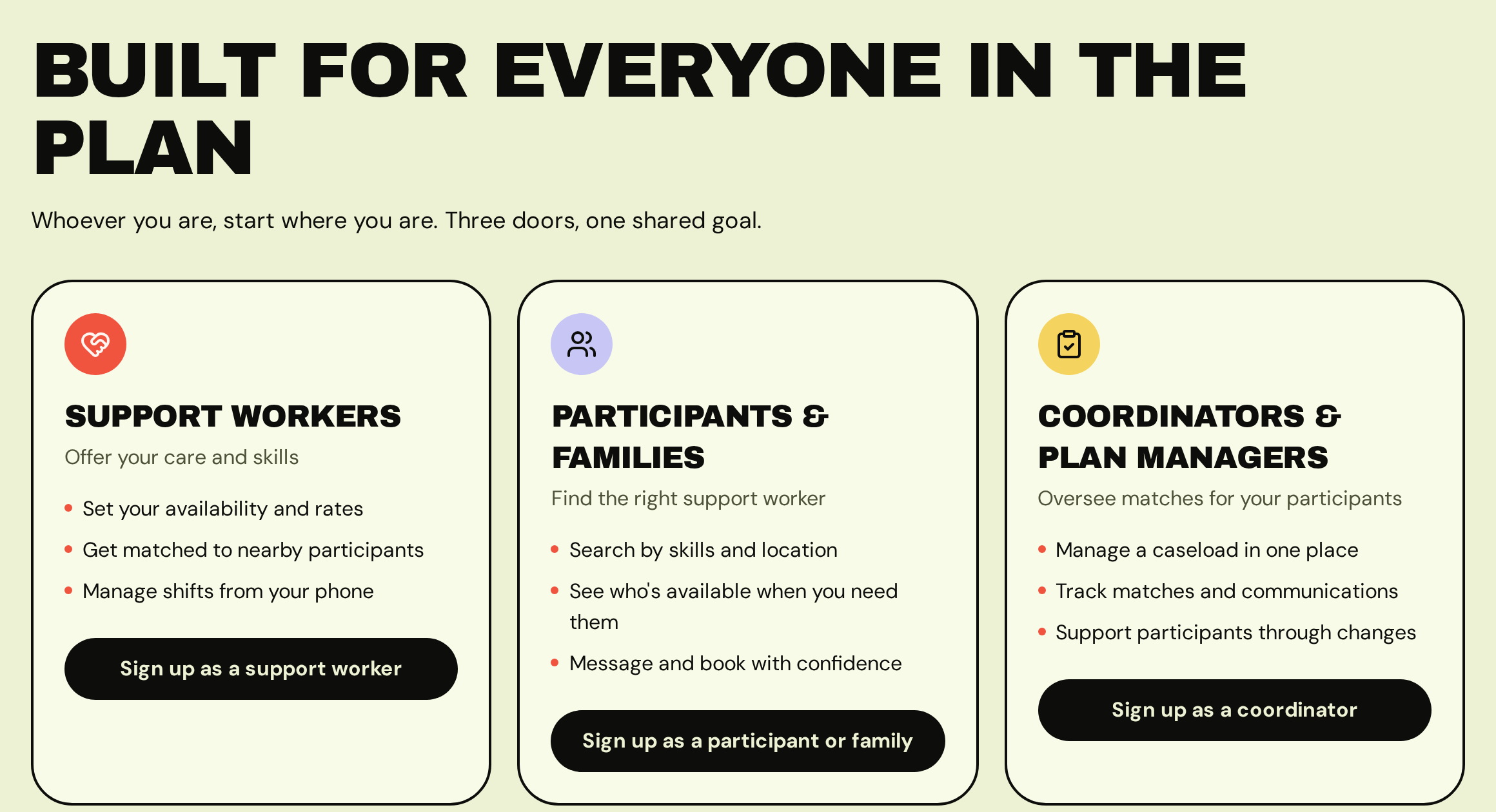
Separate entry points for support workers, participants and families, and coordinators.
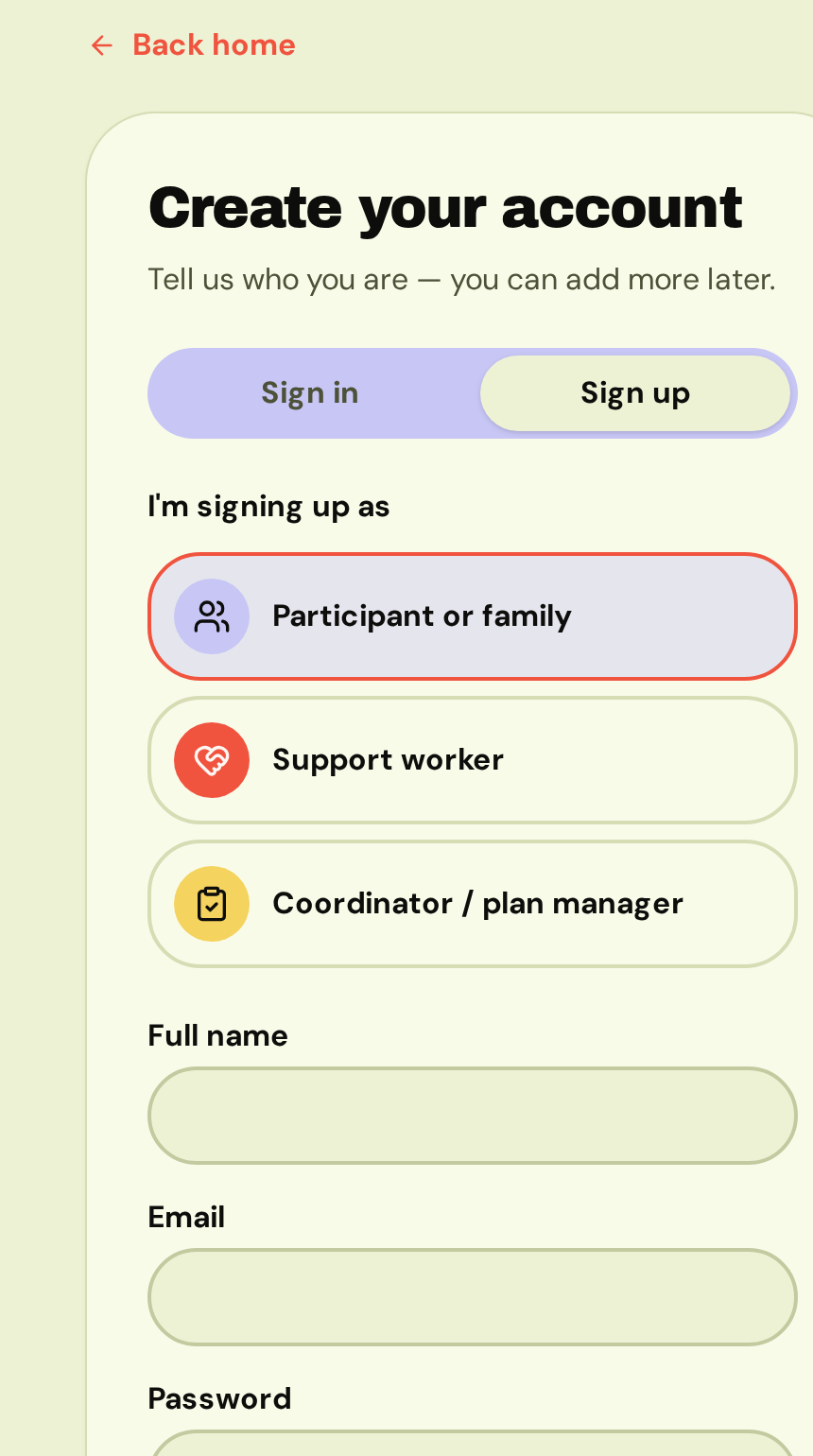
Account creation starts by asking who you are — the profile shapes everything after it.
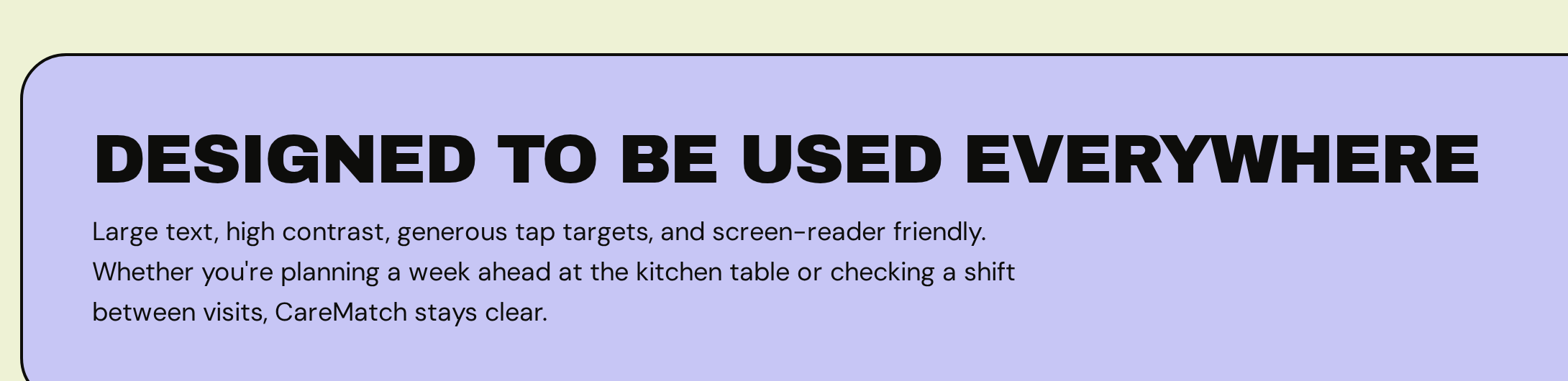
Large text, high contrast and generous tap targets carried through the whole build.
Snippets from the build
How the product speaks
Copy taken straight from the prototype — plain language, no jargon, and every audience addressed on its own terms.
Landing promise
“Find the right support worker, without the guesswork. We match NDIS participants and families with workers by skills, availability, location, and how well you actually get along.”
Support workers
“Offer your care and skills — set your availability and rates, get matched to nearby participants, manage shifts from your phone.”
Participants & families
“Find the right support worker — search by skills and location, see who's available when you need them, message and book with confidence.”
Coordinators & plan managers
“Oversee matches for your participants — manage a caseload in one place, track matches and communications, support participants through changes.”
Accessibility
“Large text, high contrast, generous tap targets, and screen-reader friendly. Whether you're planning a week ahead at the kitchen table or checking a shift between visits, CareMatch stays clear.”
Footer disclaimer
“© 2026 CareMatch. Not affiliated with the NDIA.”
Design artefact
Worker profile — concept mock
Sam K.
Support worker · Gold Coast · 3 years' experience
"I work best with participants who want an active support — surfing, walking the coast, cooking together. Calm, patient, and I keep my training current."
Concept mock · not a real profile
The NDIS promises choice and control. I've seen from the inside how rarely the system delivers it — this is what delivering it could look like.
Eimear Moore